
How Portugal charmed China
Updated: Jun 8
In the long history of East-West relations, few sagas are as misunderstood as the diplomatic dance between the Portuguese Crown and the Chinese Imperial Court. Often dismissed as a footnote to the eventual rise of the British Empire, these embassies were, in fact, masterclasses in cross-cultural navigation. While other European powers approached the "Middle Kingdom" (the direct translation of China in Chinese—中国) with a mixture of commercial aggression and Protestant rigidity, the Portuguese played a much longer, subtler game.
By exploring the successes and failures of these missions from both Lisbon and Beijing’s perspectives, we see a narrative not of simple trade, but of two civilizations learning to speak a common language of prestige and ritual.

The 1517 Disaster: The Perils of First Contact
The first official European embassy to China was led by Tomé Pires, a former apothecary and son of a pharmacist to King João II. He arrived in Guangzhou in 1517 during the reign of the Zhèngdé Emperor (正德帝) of the Ming Dynasty.
From a Portuguese perspective, Pires was an explorer-diplomat. From the Ming perspective, however, he was a representative of the Fólángjī (佛郎机)—a term derived from Persian for "Frank" used to describe aggressive outsiders. The mission was doomed by a series of cultural and geopolitical blunders:
The Malacca Connection: The Portuguese had recently conquered Malacca, a loyal tributary state of China. The deposed Sultan’s envoys were already in Beijing complaining about Portuguese "piracy."
The Salute: Upon arrival, the Portuguese ships fired their cannons in a traditional European salute. To the Chinese authorities, this was an act of extreme belligerence in a regulated port.
The Protocol: The Portuguese letters addressed the Emperor as an equal "brother" to the King of Portugal. In the Chinese world order (Tiānxià or 天下), there was only one Son of Heaven; all others were subordinates.
The Míng Shílù (明实录 or Veritable Records of the Ming) describes the Portuguese during this era as having "nature like that of dogs and sheep," noting their hunger for profit. Pires was eventually imprisoned and died in captivity. The lesson was clear: China did not want "partners"; it wanted "tributaries."
The Dutch and British: The Cost of Rigidity
To understand the Portuguese success, we must look at the failures of their rivals.
The Dutch East India Company (VOC) sent their first major embassy in 1655 (Peter de Goyer and Jacob de Keyzer) to the Qing Dynasty court of the Shùnzhì Emperor (顺治帝). Unlike the later British, the Dutch were willing to perform the kowtow—the three kneelings and nine prostrations—but they were treated as mere merchants. They returned in 1667 under van Hoorn, but despite their compliance with ritual, they failed to secure any meaningful trade concessions. The Chinese viewed them as "clever but untrustworthy."
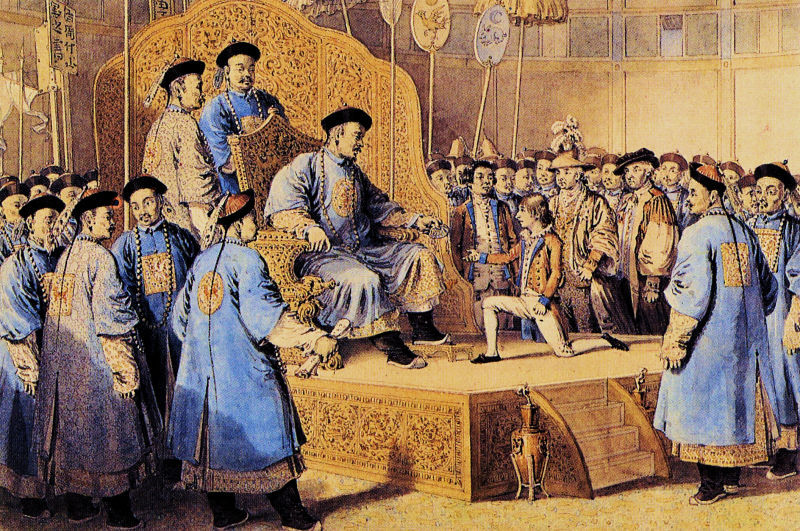
The British arrived much later, and with significantly more ego. The Macartney Embassy of 1793, sent to the Qiánlóng Emperor (乾隆帝), is perhaps the most famous failure in diplomatic history. Lord Macartney famously refused to perform the full kowtow, offering only a single knee as he would to King George III.
To the Qianlong Emperor, this was not perceived as standing up for British pride; it was a sign of a barbarian who was literally incapable of civilization. The Emperor’s famous reply—“We have never valued ingenious articles, nor do we have the slightest need of your country’s manufactures”—was not just arrogance; it was a rejection of the British refusal to acknowledge the Chinese social and spiritual order.
The Portuguese Advantage: The Jesuit Bridge
The Portuguese succeeded where the Dutch and British failed because they possessed a unique asset: the Jesuits.

By the mid-17th century, Portuguese-sponsored Jesuit missionaries like Matteo Ricci (whom the Chinese call 利玛窦) and Johann Adam Schall von Bell (汤若望) had become fixtures in the Forbidden City. They served as the Emperor’s astronomers, mathematicians, and map-makers. When a Portuguese ambassador arrived, he didn't need a random translator; he had a brother-in-faith who lived inside the Palace.
When Manuel de Saldanha arrived in 1667 to meet the Kāngxī Emperor (康熙帝), the Jesuits acted as cultural brokers. They "translated" Portuguese requests into language that fit the Chinese bureaucratic framework. They framed Portuguese presence in Macau not as a foreign occupation, but as a loyal outpost of "obedient" subjects who helped guard the coast against pirates.
The Sumptuous Embassy of 1725: Dom João V and Emperor Yongzheng
The pinnacle of this relationship was the embassy of Alexandre Metello de Sousa in 1725, sent by Dom João V to the Yōngzhèng Emperor (雍正帝).
João V, known as "The Magnanimous," was arguably the wealthiest monarch in Europe at the time, his coffers overflowing with gold and diamonds from Brazil. He wanted to project this majesty to the East. Unlike the cash-strapped missions of the past, Metello’s embassy was a spectacle of 18th-century extravagance.

The Gifts of 1725:
The exchange of gifts provides a fascinating window into what each culture valued. Metello brought:
Scientific Instruments: Telescopes and mathematical tools (which Yongzheng, a practical administrator, highly valued).
European Luxury: Mirrors, fine wines, and clocks.
The Exotic: Bezoar stones (gallstones from animals in the Indies, used in medicine) and swallow’s nests.
Religious Artifacts: Beautifully bound bibles and liturgical items, though these were handled discreetly.
The Yongzheng Emperor responded with typical imperial generosity, gifting the King of Portugal thousands of bolts of high-grade silk, exquisite porcelains, and lacquerware.
Why was it a success?
Metello performed the kowtow without hesitation. By doing so, he signaled that Portugal accepted the Chinese hierarchy. In return, Yongzheng treated the Portuguese with a level of intimacy never granted to the British. He allowed Metello to sit in his presence and even offered him wine from his own table—a rare honour for a "foreigner."
Chinese records from the period (Qíng Shílù or 清实录) note that the Portuguese were "sincere in their tribute." Because they didn't demand "free trade" (which the Chinese saw as chaotic) but instead asked for "harmony and protection" for Macau, they were viewed as manageable and loyal.

The 1753 Embassy: The Final Flourish
The last great mission was that of Francisco Xavier Assis Pacheco de Sampaio in 1753 to the Qiánlóng Emperor (乾隆帝). This embassy was so well-received that the Emperor personally composed poems in honour of the gifts and ordered the court painters to document the event.
Sampaio’s mission was the victory lap of Portuguese diplomacy. While other Europeans were increasingly seen as threats, the Portuguese had successfully rebranded themselves as a "vassal-like" partner that provided a useful window to the Western world without the territorial ambitions of the rising British or French.
The Lasting Impact: Why It Still Matters
The success of these Portuguese embassies explains why Macau remained under Portuguese administration for 442 years, while the British eventually had to resort to the gunboat diplomacy of the Opium Wars to gain a foothold in Hong Kong.

The Portuguese approach was the ultimate exercise in Realpolitik. Long before the term was coined, Lisbon understood that in Asia, dogmatic pride was a liability. While the British allowed abstract notions of national sovereignty to ruin their diplomatic chances, the Portuguese recognized the reality of their position as a fading power. They traded symbolic submission for tangible longevity. By acknowledging the Emperor’s central role, they secured a degree of autonomy and presence that mightier empires could only dream of.
Today, when we look at the ruins of St. Paul’s in Macau or the European-style clocks in the Palace Museum in Beijing, we aren't just looking at artifacts of trade. We are looking at the remnants of a time when a small nation on the edge of Europe understood the "Middle Kingdom" better than anyone else—not through force, but through the art of the bow and the gift.


Exploring how others organize input-related knowledge is rarely wasted effort. This guide is a compact example of that kind of resource.