
Lusophone Goa: Tracing the Portuguese Language
Updated: May 17

The Portuguese first reached India on 20 May 1498, when Vasco da Gama and the fleet he commanded reached Calicut (now Kozhikode in the state of Kerala) on the Malabar Coast along the southwest of India. It was only with the seventh armada to India in 1505 that King Manuel I of Portugal named Francisco de Almeida the first Viceroy of India, on condition that he build a string of forts along the Malabar Coast to protect Portuguese interests in the spice hubs of Calicut and Cochin (today's Kochi).
Afonso de Albuquerque became the second Governor of Portuguese India in 1509 after the epic Battle of Diu, and in 1510 he conquered Goa from the Sultanate of Bijapur, with the help of a local ally. Although Goa was north of the spice-trading Malabar Coast, it took over from Cochin as the capital of Portuguese India in 1530 thanks to its superior natural harbour, central location on the western coast of the Indian subcontinent, and better strategic position for controlling lucrative Arabian Sea trade routes. Goa remained the administrative hub of the entire Portuguese Eastern Empire—which stretched from East Africa all the way to Macau—until it was annexed by India in 1961.
This means that Goa was Portuguese for 451 years, an exceptionally long period that led to the development of a unique blend of Indian and Portuguese cultures, architecture, language, and cuisine that still sets it apart today. Linguistically, however, English rapidly replaced Portuguese in all administrative and education functions after 1961. 65 years later, there are today relatively few native speakers of Portuguese amongst Goans, but given that it has only been two to three generations, there are still distinct memories of the language of Camões.
Aren Noronha is a young Goan, 22 years old this year. A student of Portuguese and Lusophone Studies at Goa University, Noronha pondered questions such as: What does it mean when a language grows, spreads, then suddenly shrinks, and largely declines in a region? How does it change the collective identity of the place and the community? What do its speakers feel about such changes?
Noronha compiled and edited stories from over 40 contributors into a book, Lusophone Goa: Tracing the Portuguese Language (published by Goa 1556), that dives into the memories and journeys of people who still speak Portuguese in Goa, including members of Goa's widespread diaspora. Noronha also makes comparisons with Macau and Timor-Leste, where the Portuguese language is being actively promoted by their respective governments. With India collaborating extensively with Brazil to champion Global South causes, could this give a new relevance to Portuguese, the unifying language of the Community of Portuguese Language Countries (CPLP)?
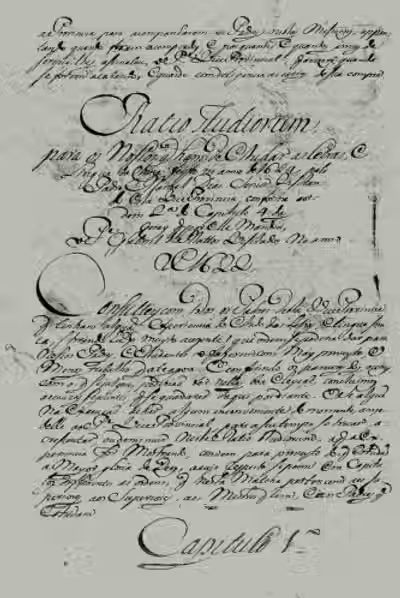
Courtesy of Aren Noronha, here is an excerpt from his book:


For anyone juggling multiple online platforms, having a single destination for all links is a practical solution. This page demonstrates how to create a unified hub that brings together content, products, and social channels. The focus on optimization is useful for improving how visitors navigate and engage with your offerings. It's a straightforward approach that saves time and provides a better experience for the audience. The tool is designed with both creators and businesses in mind. You can explore the biolinku.com platform to see how it works.